Interdimensional Spaceflow Theory
A Grand Unification Theory of Everything - Formerly titled Ethereal Flow Theory

Flow Theory is a Grand Unification Theory based on humble precepts. It grandly ties together the cosmic and quantum worlds, explains everything from the origin of the universe to the workings of atoms, gravity and time. It is based on one grand assumption and uses only simple classical, concrete mechanisms and no mathematics. The grand assumption is that the “big bang” was a four dimensional phenomenon similar to a violent gas explosion. It’s three dimensional “surface”, the boundary between it and whatever is outside it, is Space; the space of our universe, and it is still expanding everywhere. The swirling, complex flow of Space through incredibly tiny primordial black holes creates the elementary “particles” of our reality and the forces controlling them.
Flow Theory grew out of years of reading “popular science” books by noted physicists and cosmologists, and because I have little interest in or aptitude for math, trying to mentally develop a concrete, physical concept of how it all works. This decades long thought experiment, combined with my reasonably good ability to visualize three dimensional concepts (my career has been in product design) and to design solutions to real world problems has led me to “design” an alternative theory of everything.
Space
Most of us have learned that things are made of atoms and tend to think of them as hard or soft little balls making up the solid world around us and the parts of our seemingly substantial bodies. But atoms are really surprisingly empty, your body is 99.99 percent empty space. (1) If the nucleus of an atom, the protons and neutrons, was about the size of our sun, you would be most likely to find the closest electrons at a spherical diameter over fifteen times the diameter of the sun’s outermost planet. The electrons themselves, if they have any size at all, would be less than10 feet in diameter. So even in a very dense atom, like lead or uranium, with hundreds of electrons, a huge proportion of the atom would be empty space. Furthermore, the protons and neutrons are not little balls, they are made of quarks, which are speeding around in possibly “empty” space, and somewhat defining the perimeters of the proton and neutron. And the quarks, like electrons, probably have no measurable size so they would be well under 10 feet in diameter in this analogy. (2)

We don’t really know if the space within the atom is the same space as “outer” space, but we are pretty sure our reality is made up of solid, tangible stuff. So where does that solidity, the beauty and texture and touches that we enjoy and that make our existence, where does that come from?
Force
What is force? We all experience forces in our everyday lives and if we think about it we can generally identify what causes the force, what creates the pushes and pulls that make things move or holds them in place. But there are some forces that are a little more mysterious; we feel the effects of gravity constantly, but no one, including our best scientists, really know what it is, what makes it work. We run electric tools, appliances, lights, etc. which all depend on magnetism to generate the electricity, but no one really knows what causes the mysterious attraction and repulsion of the positive and negative poles of magnets.
Gravity and Electromagnetism are two of the four fundamental forces that science recognize as basic and necessary to our reality. The current theory of the atomic world, quantum field theory, calls the other two forces the Strong Force and the Weak Force, or weak interaction (B1). We are aware of the effect of these forces because we are made of them, everything in the universe, everything we see and touch, depends on the existence of these two mysterious forces. They only operate at the quantum level over very short distances within the nuclei of atoms and, like the other two, we have no understanding of what creates them. Combined with magnetism these three forces turn the vast empty voids of atoms into tangible matter and holds them together in countless ways to make us, and combined with gravity, our universe.
In the Beginning
Scientists have developed a concept of the first moments of our universe as an explosive, violent, incredibly rapid expansion of a hot, swirling, turbulent plasma-like substance from a very small beginning, popularly called The Big Bang. There has been speculation that the velocities within the turbulence momentarily approached light speed, relativistically creating high inertial mass in a “point” volume - a tiny black hole (3). Possibly an enormously huge number of them were very tiny, as small or smaller than Planck length(W) which is smaller than we can currently measure. To differentiate these from cosmic black holes, I will call them flotons.
The vast number of flotons slowed the initial exponential expansion of the plasma, but as it cooled it no longer had the energy to create black holes. The substance making up the plasma (4) continued to expand but the rate of expansion was moderated by the existence of the flotons and this process is still happening. Although we are not currently able to detect it, the expanding substance is, in effect, being continually “created” everywhere there is space, including the vast space within atoms, and it flows out of our perceived universe through floton vents, the ubiquitous primordial black holes. (4, also see “What Could Space be?” below)
Plasma is what astrophysicists tend to call the substance making up the big bang, which is descriptive of the substance but does not define what it is. For thousands of years thinkers and scientist have felt there must be something that carries the forces and energies perceived around us throughout the universe, calling it the aether, or luminiferous aether. Since they have failed to prove its existence, they shy away from using the term while still generally acknowledging that there must be “something” there, some kind of “stuff of the universe”. (5)
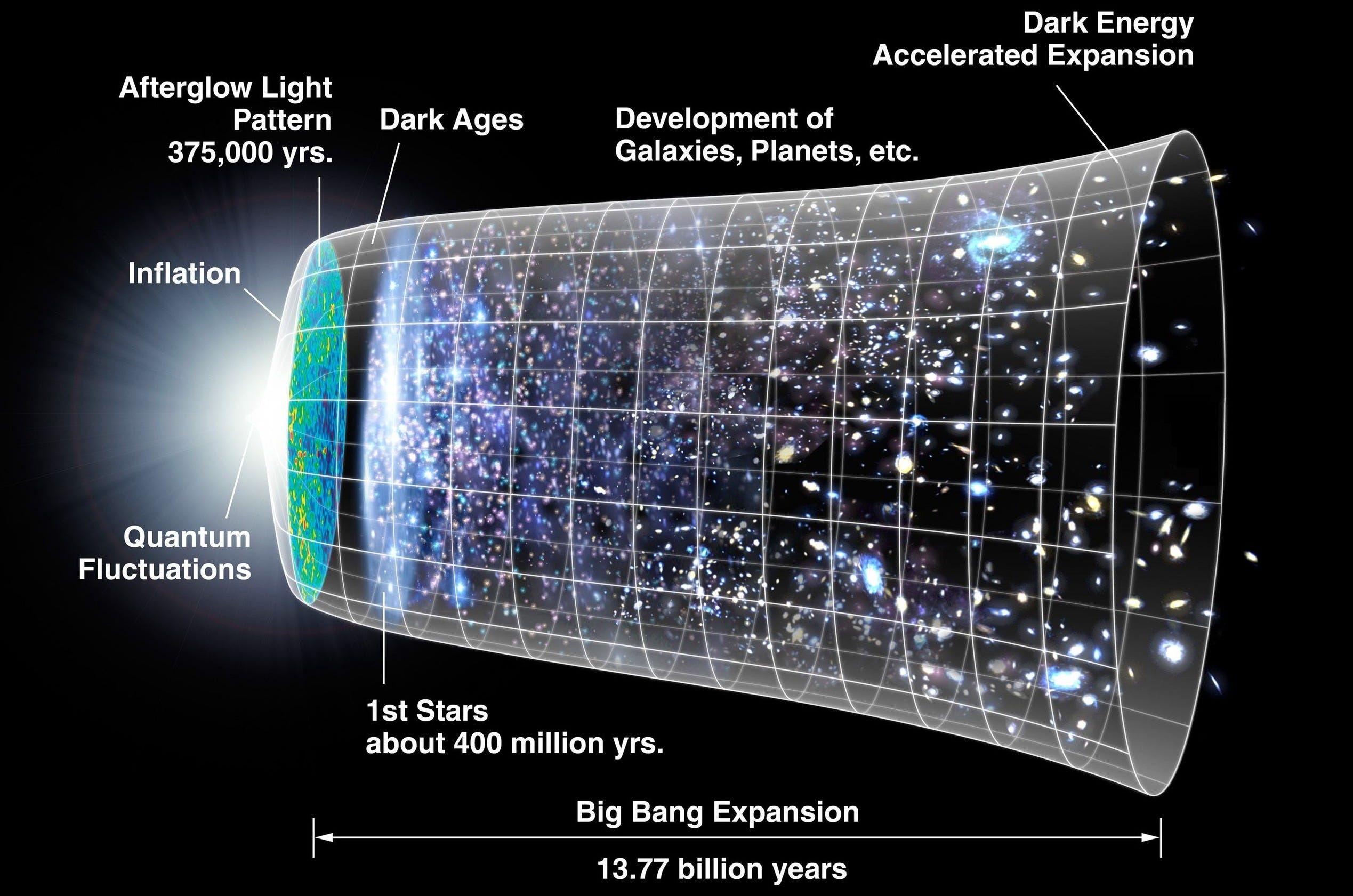
Flow Theory assumes that this “stuff” is the residual expanding substance of the Big Bang, and it doesn’t just fill all of space, it is Space.
What could Space be?
We have all seen whirlpools, water flowing down a drain, eddies in a fast flowing current, maybe even a maelstrom. The surface of a body of water is a good example of a two dimensional object, it literally has no thickness. This surface is a convoluted assemblage of swirls, flows and waves like the centers of the whirlpools which almost look like objects in the image below. This has a conceptual similarity to cosmic black holes, except with whirlpools we can imagine where the surface is “going”, as the 2D surface is swallowed up by the 3D phenomenon that creates it.
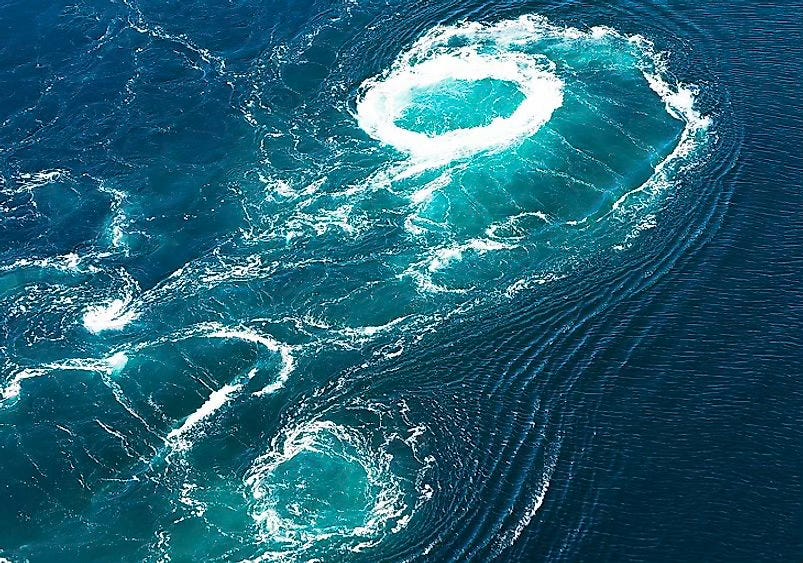
Imagine that the interference patterns and wave interactions are complex enough to create a world of cognizant creatures like the one in the book Flatland(6), and that their world is the two dimensional surface bounding an active three dimensional phenomenon. But instead of a body of water it bounds a violent gas explosion.
This boundary is a true two dimensional entity, there is no thickness or substance between the rapidly expanding gas and the air or space around it. this provides a convenient two dimensional analogy for our three dimensional universe as we have come to understand it because it can start in a very small, hot and consistent point and expand at varying rates. As the gasses explode, the surface expands; in effect it is being constantly created throughout its entirety. As the bubble expands, the gas starts to escape into the surrounding void, swirling and rotating into whirlpool-like shapes, developing tiny eruption cones stretching the surface out into points which open to let the gas escape(7). The edges of this rupture might vibrate and flutter as the gas passes through causing vibrations and waves in the surface that radiate back away from the vent like waves from a stone dropped into water. The expanding surface appears to swirl and flow as it disappears into the eruption cones drawing them together if the flow rate exceeds the expansion rate.
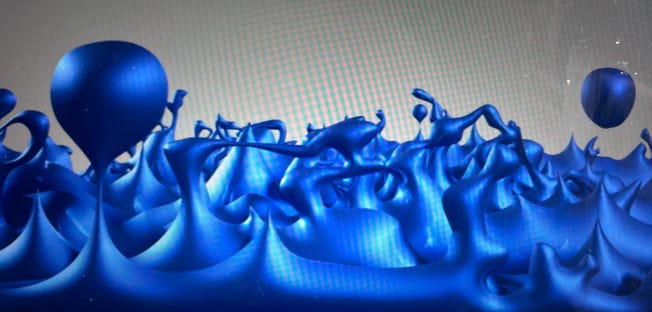
It is important not to confuse the explosive phenomenon creating the surface with the surface itself. As the underlying phenomenon, the expanding gas, escapes through the vents, the surface goes with it and ceases to exist as the gas diffuses into whatever surrounds it. The surface, constantly being created and expanding, is what would create the two dimensional world of the Flatlanders. But for it to have the shapes and waves that interact to create it’s features, it must exist in a three dimensional universe. And while its features are created by the interaction of the 3D entities, the surface still has no thickness, it is not detectable as an entity, either from the point of view of the 3D world or that of the Flatlanders residing there. This surface is Flatland’s Space.
So what could our Space be? The above analogy is an explanation of an aether that we can’t detect and it does provide a conceivable scenario. I have no experimental proof, mathematics or publications to support it and am open to other explanations. That said, similar to the above analogy, our aether, Space, could be the 3D boundary of a four dimensional phenomenon. (8)
This constantly expanding Space, still happening everywhere, including the interior of atoms, swirling and vibrating as it passes through flotons, is all there is. Our reality is the result.
Inayat Khan tells a Hindu story that has some relevance to this unobservable sea. A fish went to the Queen fish and asked: "I have always heard about the sea, but what is the sea? Where is it?" The Queen fish replied: "You live, move, and have your being in the sea. The sea is within you and without you, and you are made of sea and you will end in sea. The sea surrounds you as your own being." Reference: P. Reps, Zen Flesh, Zen Bones pg. 211 (9)
Matter - Mass and Gravity
The fundamental mechanism of our reality is the flow of Space through tiny, primordial black holes. At it’s base level this creates gravity, the force that is trying pull everything together. Early plasma/Space, being a turbulent and unorganized entity, had areas with greater and lesser concentrations of flotons. As Space flowed through the flotons, it tended to pull them together and denser areas tended to reach an equilibrium balancing the rate of flow with the rate of expansion. There was probably a variety of “shapes” to the flow, the way it rotated or swirled as it neared and entered the floton vents, and roughly 15% of them developed stable flow patterns. These became the “particles” of atomic construction and, as I explain below, their interactions create the structure and forces making up our perceived universe. Unorganized, inconsistent flow patterns into vents made up the remaining 85% or so and created what we call dark matter.
As Space nears and passes the event horizon of the vent, the flow is intensified and localized, creating the effect considered to be inertial gravity which we identify and measure as mass. And as Space in the less dense regions continues to expand it causes our universe to also expand; this is the source of what we call dark energy. Similarly the random particles that are observed in particle accelerator collisions would have chaotic flows that are temporarily organized by the collider process and devolve back into dark matter very quickly, as do random “particles” that “appear out of nowhere”(10).
Force
The 15 percent of flotons that have consistent, organized flows are the electrons and quarks(W) that, as far as we currently know, are the most fundamental objects that form our reality. Since they have mass but are generally thought to have no measurable dimensions, science calls them “point particles” which could be considered a description of a tiny black hole. They are also considered to be Spinors. If you Google spinors you get definitions like this one from Wikipedia: “Although spinors can be defined purely as elements of a representation space of the spin group (or its Lie algebra of infinitesimal rotations), they are typically defined as elements of a vector space that carries a linear representation of the Clifford algebra”, and most explanations quickly resort to some very complex mathematics. (11)
However, the concept of spinors is very important to Flow Theory because this defines the way Spatial flow is shaped in atoms, and consequently, our reality. In our classical, non-quantum world things spin around a single axis. If a ribbon is attached to the object and the other end attached to a fixed point, the ribbon will be continually twisted or wound up, getting worse with every revolution. But if you attach a ribbon to a spinor, it will be returned to it’s original configuration every second rotation, it will twist 360 degrees on the first rotation and untwist on the second.
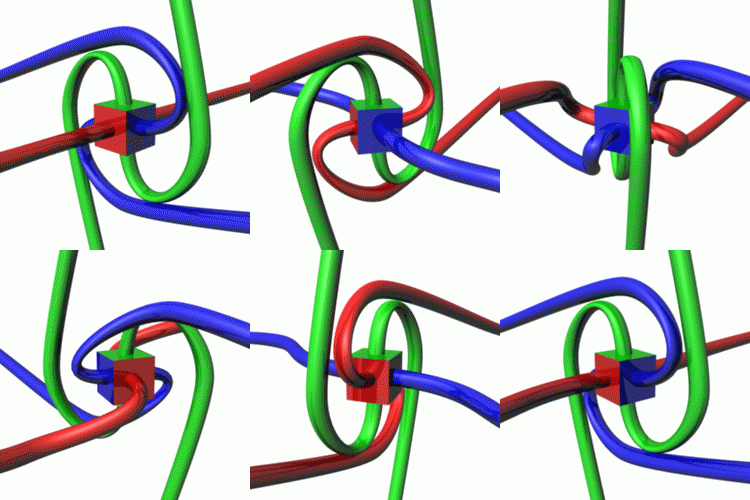
https://commons.wikimedia.org/wiki/File:Belt_Trick.ogv
Animation 1
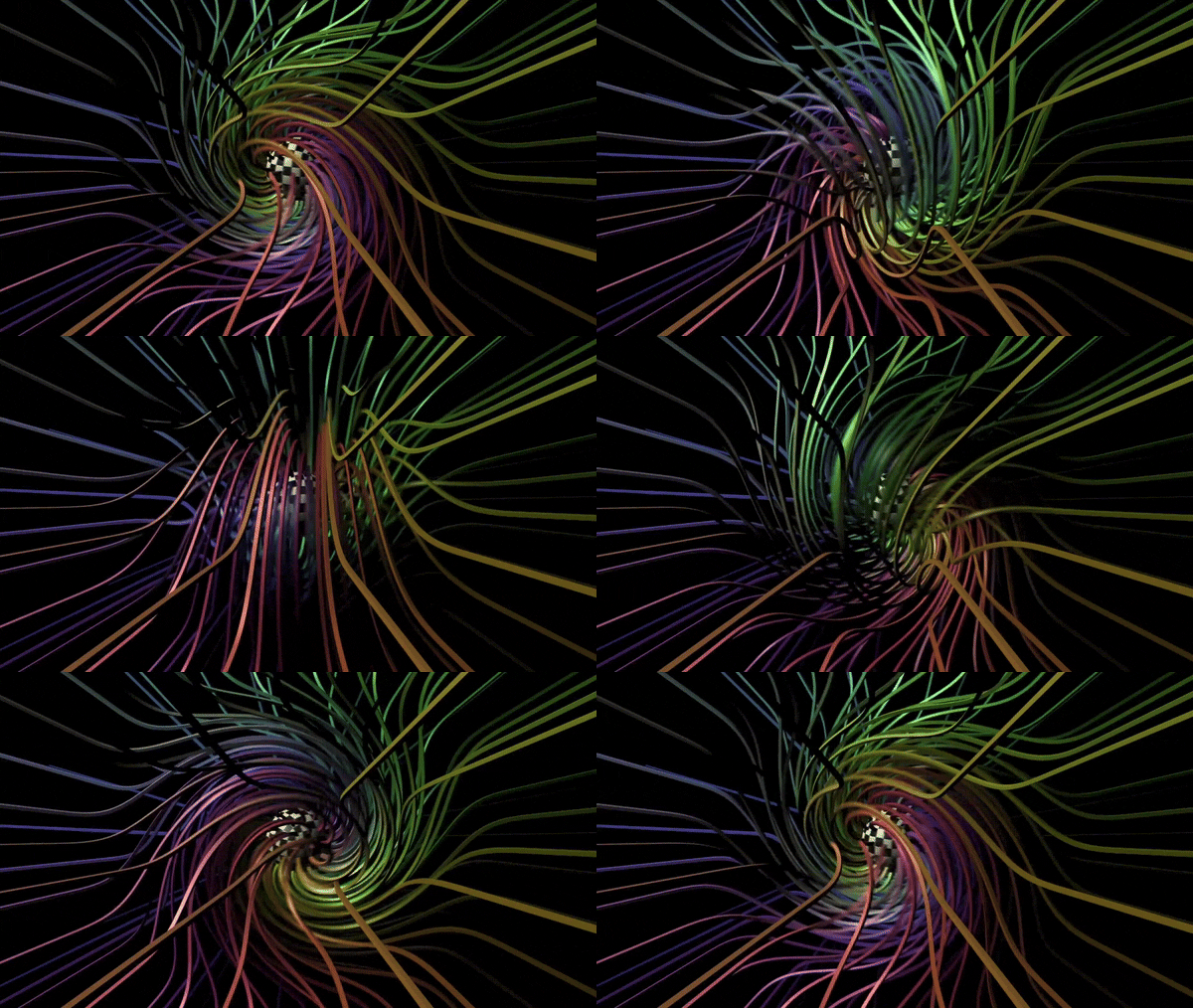
It is important to note that in Flow Theory, spinor is not a description of the motion of the object, (it’s not clear whether a point particle or a black hole is even an “object”), it is a description of what is happening around the “object”. Imagine that the belts in the animation below are the flow lines of Space into a floton. While it is a complex, three dimensional flow, it still has a “handedness” or chirality, (more obvious in the gif above), and this creates the mechanism for all the interactions of electrons and quarks. This is the basis of how gravity is converted to all the other known forces, electromagnetic, strong and weak.
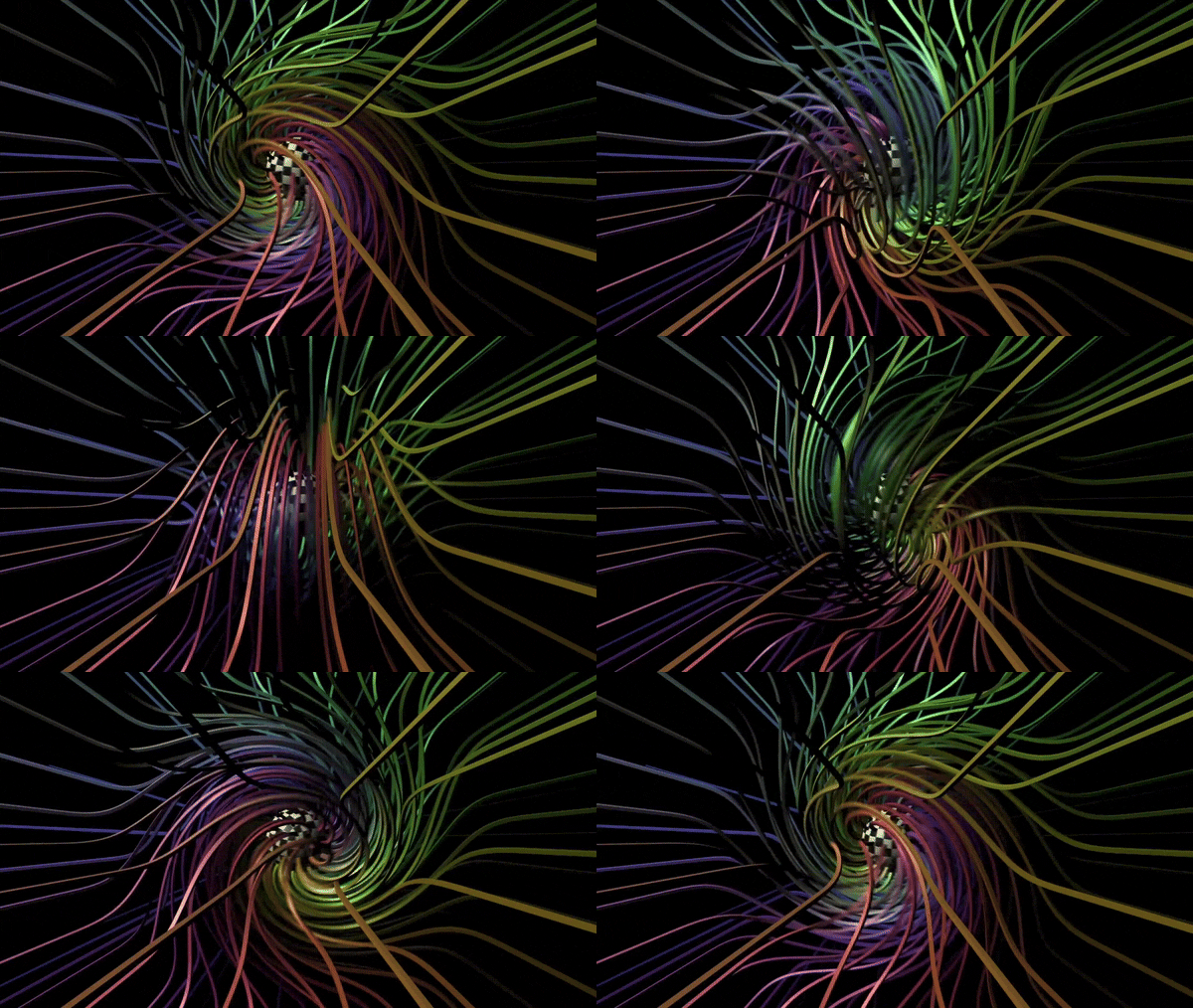
Animation 2
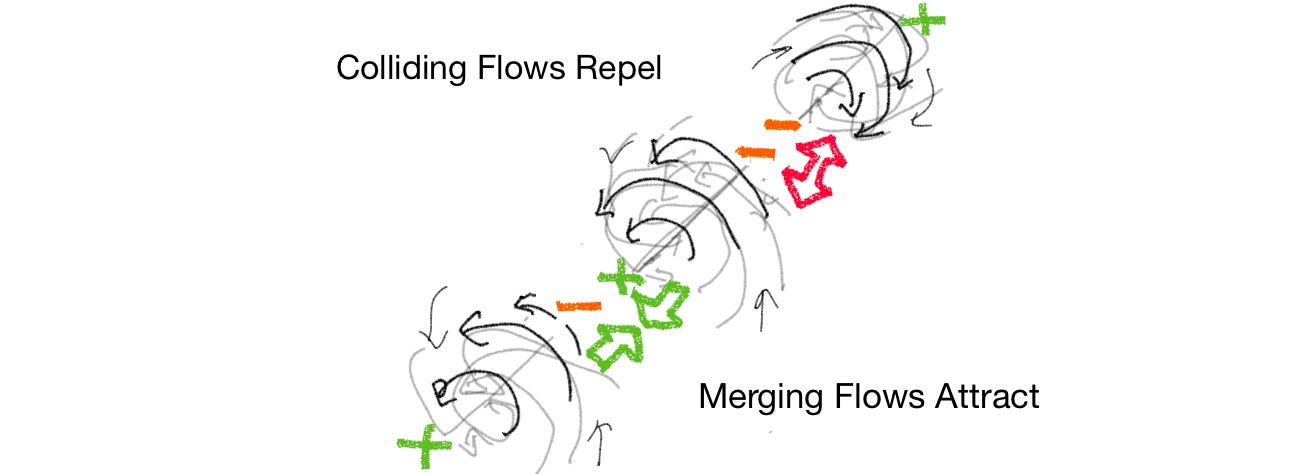
The drawing below illustrates the dynamic effects caused by adjacent spiraling fluids. Fluids rotating the same direction will tend to repel each other because the flows oppose and slow down in the area between them causing more pressure than the faster flowing material on the opposite sides. Conversely, counter-rotating flows will attract as the flow is sped up at the juncture reducing the pressure compared to the slower moving material on the opposite sides.
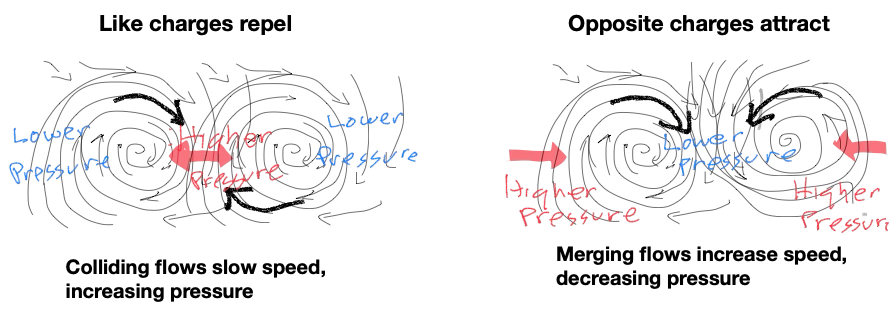
As you can see in animation 1 the flow creating a spinor has a definite axis of rotation. This has two related effects; the flow’s swirling motion creates a complex 3D version of the illustrations above, causing charge so that like rotations repel and opposites attract, and magnetism. (See section below and appendix C). A basic unbound spinor, of course, is a little more complicated in that the axis rotates 180 degrees with each 360 degree swirl of the incoming flow, giving rise to the phenomenon known as superposition; they seem to be spinning both ways at once. In Appendix (A) I will suggest how this might be possible.
Because the flow into flotons has the characteristics of a spinor, the sketches above are more like a cross section of the flow at a point in time. More accurate representations of spinor flow in the complex interactions of quantum objects will be suggested in Appendix (A) but might better be described by fluid flow software modeling and is beyond the scope of this essay. (Document?)
ATOMS
Atoms, as mentioned in the introduction, appear to be mostly empty space, but Flow Theory proposes that Space is a dynamic, forceful entity and the shape of it’s movement, it’s expansion and flow, creates the fundamental features that define atoms. Earlier I described how the atom appears to be a vast empty space with some tiny mostly positively charged spots in the center (quarks) and some tiny negatively charged spots (electrons) moving around a relatively enormous distance away. This space, as well as the space separating atoms, is also Space, expanding and constantly being “created”. The nucleus is made up of protons and neutrons, which are themselves made up of quarks. As far as we know there is nothing else in the nucleus except what physicists call gluons which control the motion of the quarks. In Flow Theory the shape and swirl of the flow does the work of gluons.
Protons have a generally right-handed flow, considered a positive charge, and with neutrons, vent much of the flow into the atom. This tends to draw the electrons, which have a net negative charge, toward the nucleus. But as the electrons are drawn closer their negative, left-handed spinning flows interfere with each other preventing them from being drawn together and keeping them at incremental distances from the center. The spiraling swirl of Space around each electron tends to spread out over the somewhat spherical perimeter of the atom, the extent of the swirl limits the electrons closest to the nucleus to two, the next “shell” of electrons to eight and so on at two times the shell number squared. The farther away they are the less bound they are to the atom allowing them to be shared with other atoms forming molecules and to be nudged along in conductive materials to carry electrical currents. (Appendix C)
The term “shell” is a simplification of the way electrons are distributed around the nucleus. Chemist have used a system called Spherical Harmonics(W) which uses the wave functions of electrons to imagine the shapes of electron clouds.
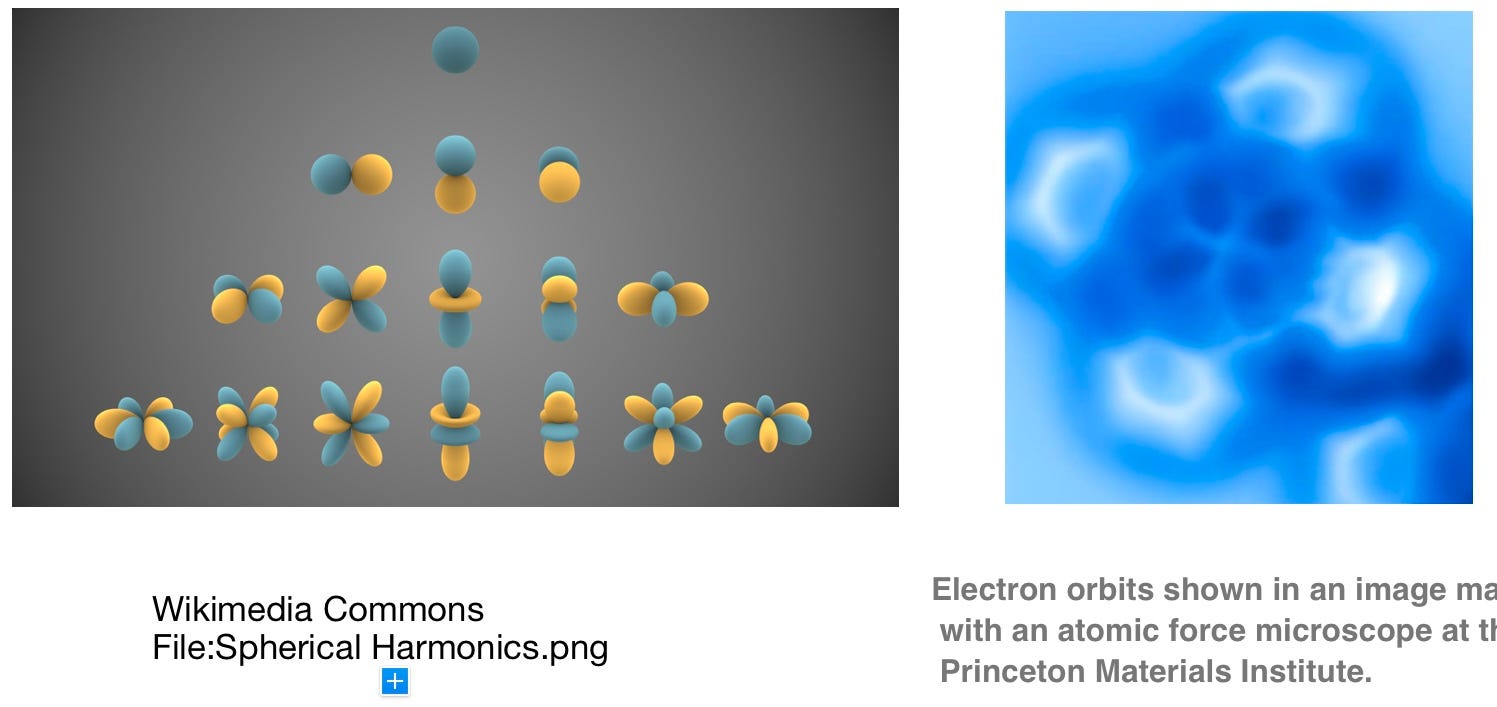
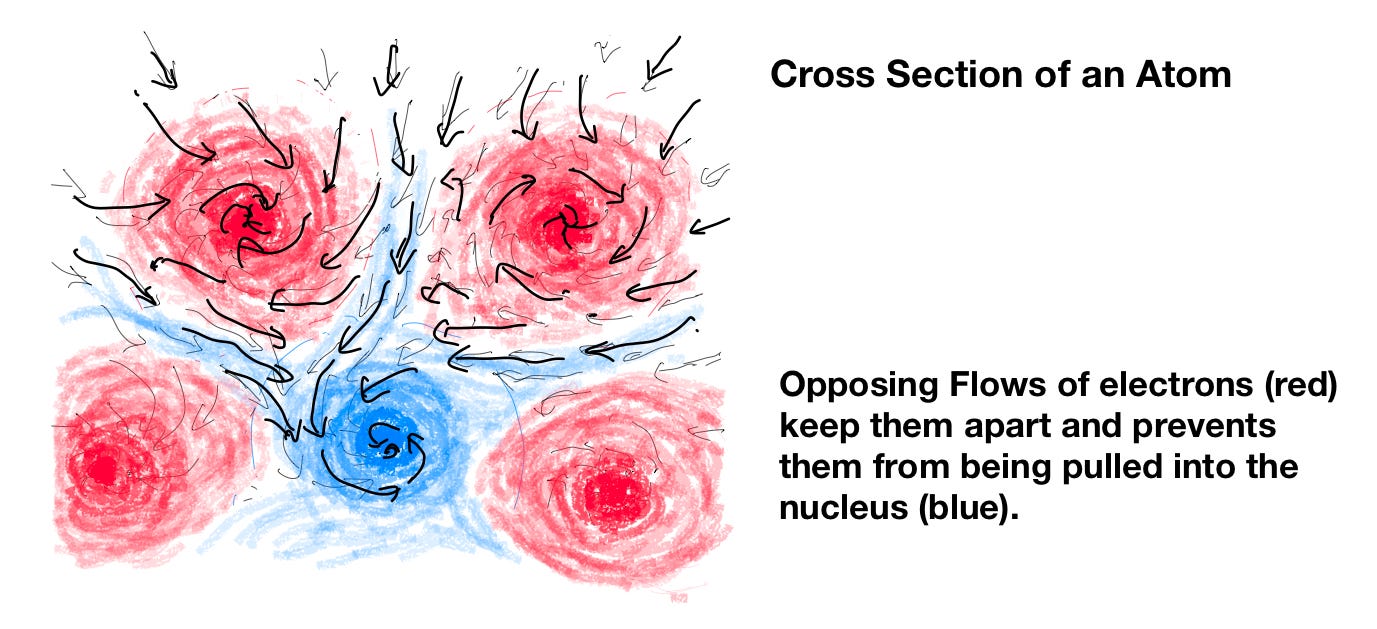
In the image made by the Princeton Materials Institute on the right above the four dark egg shaped spots in the center are the force fields of some of the electrons in an iron atom. The image is quite similar to the shapes calculated by spherical harmonics.(12)
Electrons and Quarks
The floton creating the electron’s “left-handed” flow appears to be extremely consistent in “size”, mass and/or energy, and possibly is the smallest possible floton. It’s energy level, e, is used as a standard in describing the energy levels of other quantum objects. The electron might be the single elementary floton, the single basic building block of our perceived reality and possibly is equivalent to the Planck Length. (W,13, and Appendix B)
While electrons are very stable and can exist independently from atoms, quarks, on the other hand, do not appear to exist independently; they stay bound together creating protons and neutrons. Since they are too small to be observed directly by any current means, what we know of them comes from collider data, usually electrons shot at atomic nuclei at near light speed. The debris and the deflected electron’s trajectories detected from numerous collisions are analyzed and patterns interpreted to attempt to identify what is in there. These experiments have consistently identified three objects called valence quarks and have also resulted in many strange and unlikely floton vents besides the valence quarks, most much larger, some even more massive than the entire proton, that disorganize and disappear extremely quickly. These “sea quarks” are likely flotons that have un-detectable, disorganized flows that are temporarily organized and energized by the enormous energy of the accelerator collision.
Measured at rest, valence quarks would only make up a very small percentage of the mass of protons and neutrons, but they seem to be moving back and forth very fast, near light speed, as if bound by rubber bands. Einstein’s famous formula can convert the energy of that motion into mass but it’s still not enough to make up the masses of protons and neutrons. The sea quarks do not contribute spin or charge characteristics to hadrons and probably aren’t fermions until temporarily organized in colliders but they do contribute mass; enough mass (flow) to contain the speedy valence quarks within hadrons and enough flow to hold the positively charged protons together even though they want to repel each other, and to keep neutrons in their place. This effect is considered the Strong Force.(14)
The vigorous oscillating motion of quarks within the proton-neutron pairs in the nucleus would create waves radiating back into the flow; their frequency creating a resonance, a series of radiating pulses of energy that organizes the spacing of electron shells. The amplitude, or power, of the waves increases with the number or proton-neutron pairs enabling the nucleus to hold on to more and more electrons in direct proportion to the total quarks involved. The Left-handed swirling cloud of Spatial flow around each electron creates the negative charge that keeps the electrons in each shell away from each other and occupying the same exact energy level. (W on Pauli Exclusion Principle)
The flow into quarks that creates the Strong Force might also be thought of as quantum gravity. Since this flow also facilitates and moderates the motion of valence quarks it creates what conventional theory calls Gluons, a type of Gauge Boson. There is much yet to be discovered about quarks and, consequently, much conjecture; some of which is discussed in appendix B, including mention of the Weak Force.
Quarks and electrons vent all the Space being created within the atom’s perimeter and also a bit more, resulting in the gravity we experience that holds our observed world together. Along with the flow of Space into disorganized flotons, ie dark matter, this residual flow creates universal gravity which is very weak compared to the gravity holding atoms together.
Light, Magnetism and Electricity
We can see light, we feel heat, have had x-rays; TV and radio communications come to us from remote locations - these are all part of the spectrum of electromagnetic radiation (EMR) that permeates the universe, from the extremely long low frequency waves of gravity to dangerous high frequency x-rays and gamma rays.(W) Perturbations in the flow of Space, chemical and atomic interactions, pulsations of the flow into flotons, etc. cause vibrations which create waves that travel through the flow. These vibrations impact atoms and molecules in various ways: causing chemical reactions in our eyes, allowing us to perceive visible light, vibrating the molecules in our skin so we feel heat. Detected by antennae they provide us with entertainment and communication. The presence of massive celestial objects warps and distorts the flow of Space in the same manner as Einstein theorized that they warp and distort the space-time continuum so that light and other waves are bent as they travel through the flow, creating gravitational lensing.
However EMR is not the same as EMF. Electromagnetic Force is one of the four forces mentioned in the introduction. As shown earlier, the chirality, the right or left handedness of the flow into flotons creates the attraction and repulsion of flotons.
The magnetism part of EMF is created by the orientation of electrons, each one is a tiny magnet and aligning their spin axes causes whatever material they inhabit to also be magnetic. (Ordinarily, the spin axis of spinor flow is also rotating; how it might be stabilized is explained in Appendix A.)
“A ferromagnet, like a paramagnetic [not intrinsically magnetic] substance , has unpaired electrons. However, in addition to the electrons' intrinsic magnetic moment's tendency to be parallel to an applied field, there is also in these materials a tendency for these magnetic moments to orient parallel to each other to maintain a lowered-energy state. Thus, even in the absence of an applied field, the magnetic moments of the electrons in the material spontaneously line up parallel to one another.” (W)
When a magnet moves through a coil of a material with lightly bound electrons, like copper, it causes lightly bound electrons on the surface of the coiled wire to move along that surface, pushing the electrons ahead of their motion somewhat like water in a hose. This action creates electricity, the “electro” part of EMF, but how that happens in Flow Theory is not completely understood. It is likely too complex to sketch here but might be an appropriate candidate for fluid flow software analysis.
More Detail
The appendices will attempt to provide more detail and investigate some of the phenomena that might not be explained in this overview of Flow Theory such as beta decay,, how spinors really work, could quarks be composed of smaller objects. So far I have not determined how to apply the theory to the collapse of wave function, entanglement, antimatter, Hawking Radiation, and likely many other subtleties of quantum theory that I am not familiar with. How Flow Theory facilitates chemistry, the combinations of atoms, is a subject for future discussion.
Now is the edge of the universe.
As the four dimensional event creating Space vents out and dissipates into the 4D volume around it, it’s boundary, our universe, Space, ceases to exist. This is an ongoing, continuous event perceived by us as the passage of time and it is created by the existence of a fourth ordinate dimension. So, in a way, time is the fourth dimension, consistent with Einstein’s theories of relativity.
Fermions exist at this boundary where Space ceases to exist. See Appendix A
Although we can imagine time extending into the future, our perception of it stops at now. As we attempt to peer into the workings of elementary “particles”, fermions, flotons, we are attempting to look past now and into the future. Since our universe ceases to exist as Space disappears into the fourth dimension, the future itself doesn’t exist, it doesn’t happen until it happens. It is all indeterminate; we can make predictions, calculate probabilities but we still don’t know if Schrodinger’s cat is dead or alive until we open the box(W). (15)
Endnotes:
(W) Any reference indicated by (W) refers to the Wikipedia entry for that subject.)
Searching this claim results in general agreement that the sub-atomic “particles” making up reality have no recognizable size, i.e. Wikipedia. Current quantum theory says it’s all waves and energy but doesn’t really explain what carries the waves or provides the energy. Ethan Siegal provides an easily understood version of current Quantum Theory in this Forbes Magazine column “Starts with a Bang”: https://www.forbes.com/sites/startswithabang/2020/04/16/you-are-not-mostly-empty-space/
(2). An atom, for instance, is typically 10-10 meters across, yet almost all of the size of the atom is unoccupied “empty” space available to the point-charge electrons surrounding the nucleus. The distance across an atomic nucleus of average size is roughly 10-14 meters—only 1/10,000 the diameter of the atom. https://www.britannica.com/science /subatomic-particle
(3) M=E/C2 so Energy = Mass times the speed of light (C) squared. Einstein’s familiar formula says that there is a tremendous amount of energy in a small amount of mass, or conversely that it if there is enough energy, like Space flowing very rapidly through a tiny hole into another dimension, it can create what is called inertial mass. Flow theory will show that all mass is inertial mass.
(4) Hawking Radiation(W) predicts that black holes will eventually radiate all the information going into them and dissipate. While this may apply to cosmic black holes, sub-atomic primordial black holes in flow theory would only be venting Spacial Flow and have nothing considered information flowing into them.
(5) “Plasma” might be a bit of a misnomer, because it actually behaves more like a fluid, in that it flows.” Helen Caines, a physicist at Yale University. Wired Magazine: https://omny.fm/shows/wired-science/the-little-bang-helping-physicists-study-the-infan/embed?style=artwork
(6) The book Flatland was written in the latter 1800’s as a political commentary concerning the repression of scientific belief. It used the analogy of residents of a 2d universe being visited by a 3d entity and descriptions of how a 2d being might perceive the visitor’s world.
(7) “Understanding Vented Gas Explosions”. Risto Lautkaski. https://www.osti.gov/etdeweb/servlets/purl/591688
(8), At the end of his presentation of General Relativity (Leiden University, 1920), Einstein said that “…..space without ether is unthinkable.” Physicists and Astronomers speak of the “fabric” or the “stuff” of space, ie Chapter 10 of Robert Laughlin’s A Different Universe, “The Fabric of Space-time”. At one point Newton thought that there was an aether that flowed into the earth, (W) creating gravity.
(9) Thanks to David Harrison from his article on Antimatter in LibreTexts: https://phys.libretexts.org/Bookshelves/Modern_Physics/Supplemental_Modules_(Modern_Physics)/Antimatt
(10) Virtual Particles (W)
(11) Electrons. Ref W entry on Spinors being fermions
(12) These images are simplified versions for clarity, mostly from leaving out the first “orbital” electrons. An excellent comparison of actual atom images with those created by Spherical Harmonics can be found at: https://doi.org/10.1038/s41467-023-37023-9
(13) “At the Planck length scale, the strength of gravity is expected to become comparable with the other forces, and it has been theorized that all the fundamental forces are unified at that scale, but the exact mechanism of this unification remains unknown.”(W on Planck Length)
(14) “Quarks move within the nucleon at relativistic speeds. This causes inertia. This inertia results in gravitational mass-effect. For short distances this is the strong force, for distant objects it is gravity. This is due to an increase in the gravitational constant related to the velocity of objects moving at speeds close to the speed of light.” From “Journal of Modern Physics” Vol.06 No.13(2015), Article ID:60688,4 pages
10.4236/jmp.2015.613189. “Gravity and Quark Velocity Entanglement”.
(15). Three lecturers from a series given by Stanford physicist Leonard Susskind discuss how a black hole might expand inward. https://arxiv.org/pdf/1810.11563.pdf A lay translation of this was posted on Sciencealert.com by Mike Mccrae in August of 2021 which uses the common two dimensional analogy for gravity of a heavy weight on a rubber sheet, only taken to the extreme of it making a very deep pit of a dent that is in effect expanding the 2d surface “inward”. https://www.sciencealert.com/why-don-t-black-holes-swallow-all-of-space?utm_campaign=AppleNews&utm_medium=referral&utm_source=AppleNews
This is much like how a deep whirlpool stretches the surface of a body of water, a true 2d entity, into the third dimension. Bringing this analogy back to black holes in our perceived 3d universe pretty much requires another spatial dimension.
Appendix A: Spin, Superposition and Now
Fermion spin is not an observed property, it is a mathematical construct developed by Paul Dirac in the1920’s to explain the results of the Stern-Gerlatch experiment (W) which showed that atomic objects have some kind of spin that is different than our human scale perception of spin. Scientists expected negatively charged electrons to be attracted by the positive side of the apparatus but when they were attracted to both sides in roughly equal proportions they realized quantum scale objects did not behave like “real world” classical objects.
Dirac’s equation uses a fourth dimension, time, to describe quantum spin, it suggests an ongoing process that can’t be explained as a fixed moment which may be why scientists have had a problem describing the spin of atomic objects in non-abstract terms. (A1) This mathematical model of the spinor, called a Dirac spinor, describes electrons (and protons) as simultaneously having left and right handed spin, a property called superposition. Yet we only experience electrons as negatively charged, left hand spinning objects, how can that be?
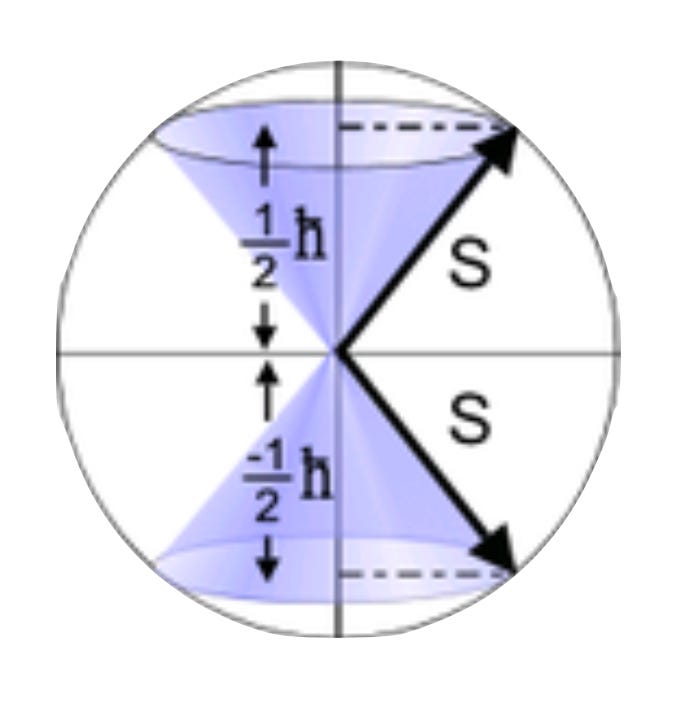
While spinors can be dramatically visualized like the GIF below, scientists often visually describe Dirac’s equation like the Spinor illustration below it.
A representation of the flow pattern of a spinor might look like two toy tops spinning on the same axis with their sharp ends fastened together. In addition the axis may wobble like a top, or precess, and can twirl like a baton twirler’s baton around the point in the middle.
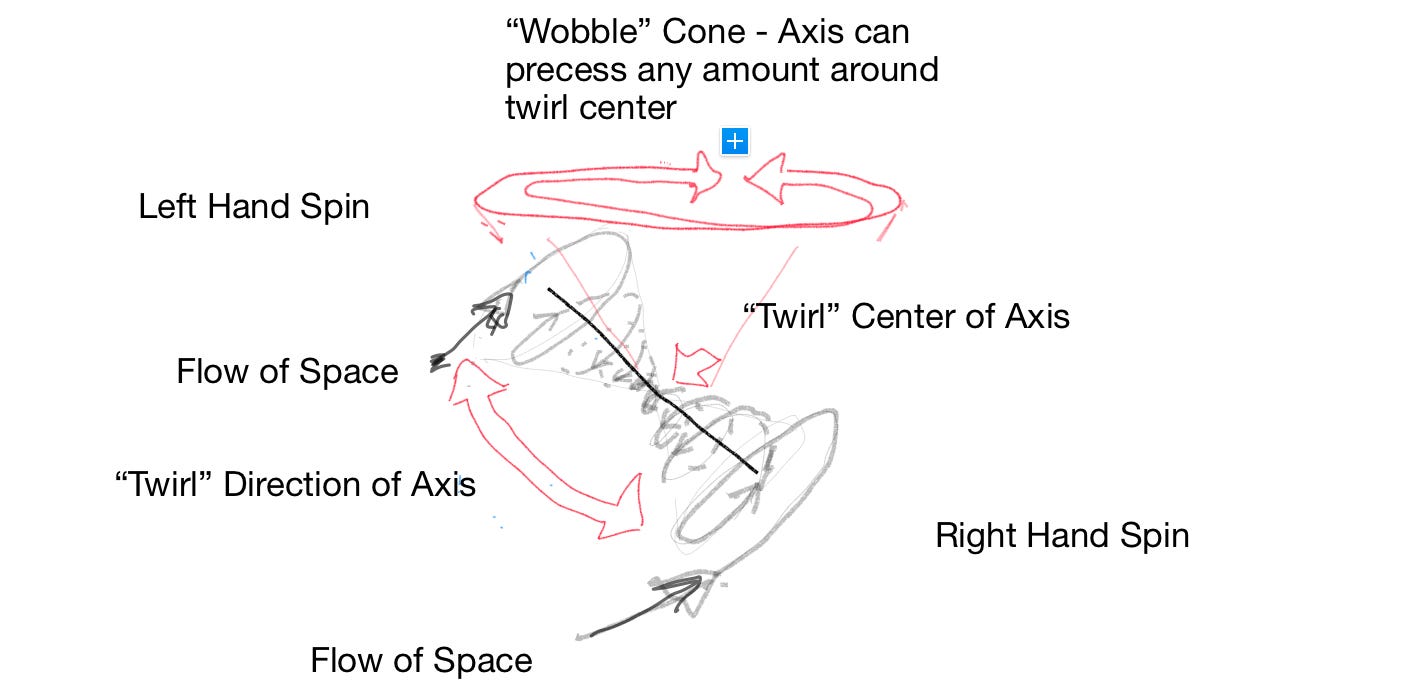
Notice that even though the flow’s direction of rotation around the axis is the same on either side of the center, one end has Left Handed Chirality, the negative “charge” of an electron, and the other end has Right Handed Chirality, the positive “charge” of the positron. This is the basis of Superposition, how flotons seem to spin both ways at once.
So what’s the point - the point in the center that is? The illustration of Minkowski Space-time (W) below bears a remarkable similarity to the spinor representations above. The bottom cone is the time path of of all the events in the past, the upper being the same for the future and the plane in the middle represents the instant of “now”, the present moment. Flow Theory suggests that fermions, flotons, exist at that point where the past meets the future, where our expanding Space dissipates into the fourth dimensional void.
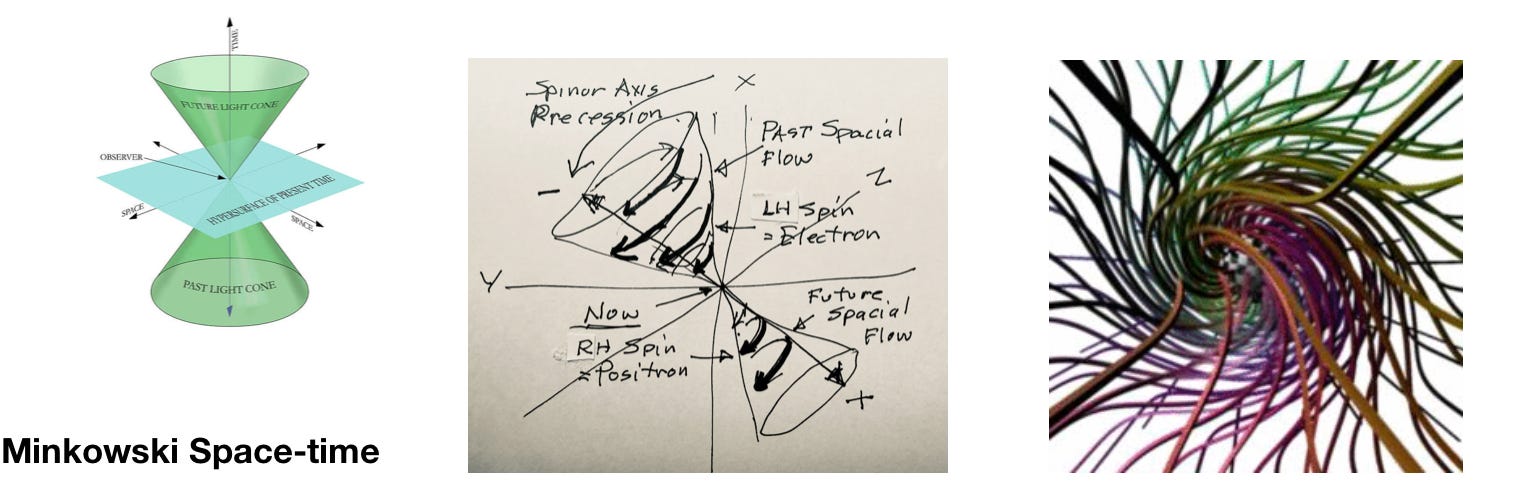
Applying Minkowski Space-time to the visualization of the flow of space in a Spinor and the math derived Spinor picture yields the illustration in the middle above. Of course these pictures are only two dimensional representations of what we perceive as a three dimensional phenomenon that actually exists in four dimensional space-time.
What we might perceive, if we could perceive the flow of Space, is more like the spinor representation on the right above; the past Spatial flow is the somewhat spherical “outside” of the flow as it swirls into now, the floton in the center. We only detect the “outside” half of the spinor, the other half is on the “other side” of the Spinor which is deep inside the center of the primordial black hole, implying that it might exist in the future. It is the orientation of the axis that determines whether we detect an electron or a positron and that is controlled by the attracting Spatial swirls creating magnetism. For instance, the left handed negative end of the floton swirl is attracted to the positive right hand net swirl of the proton, free electrons in a cathode ray tube are directed by a homogenous, orderly magnetic field maintaining their negative “charge”. But in the unhomogenous field of the Stern-Gerlatch experiment, the axes of free electrons is “twirling” and they are attracted to the negative or positive poles depending on which half is on the 3d outside of the floton.
This concept of spin might also explain the mysterious neutrino, which has no charge. It could be a floton whose spin axis is “twirling” very rapidly around the “now” point so it transitions from positive to negative too fast to exhibit any perceptable charge.
It is interesting that the mathematical derivation of a Spinor is “spin 1/2” and the above analysis identifies the Spinor as only presenting 1/2 of itself at time. And it is possible that the floton vent in the center is a lot farther away than the perceived radius of the swirl (admittedly the outer edges are pretty fuzzy), like looking at a photograph taken looking directly into a deep whirlpool doesn’t tell you how far it is to the bottom. This may be why it might be very difficult to measure phenomena smaller than Planck length, objects in the collider may be farther away than they appear.
This raises an interesting though somewhat oxymoronic concept. The process of looking into a spinor seems to involve trying to “see” into a smaller and smaller space yet if FlowTheory is correct, we are really trying to look into a larger dimension that our universe resides in. Could this have implications relative to string theory? Are what seem to be string theory’s tiny dimensions actually higher dimensions within which our universe exists?
Notes
A1 - Spin seems like such a simple concept in our massive world of reality but quantum physics has compelled countless physicists and mathematicians to perform incredible mental gyrations (another word for spin?) to explain what is going on in there. Intrinsic angular momentum, chirality, helicity, handedness, spin-up and spin-down - all these terms are verbally massaged to incoherence; endless, incredibly detailed mathematic descriptions attempt to describe the actions of quantum phenomena. This all might be Wolfgang Pauli’s fault; the following comment is buried somewhere deep in the huge Wikipedia entry on spin (physics):
“In retrospect this (Pauli’s) insistence and the style of his proof initiated the modern particle physics era, where abstract quantum properties derived from symmetry properties dominate. Concrete interpretation became secondary and optional.”
If our universe is truly a three dimensional result of a four dimensional phenomenon, black holes, point “particles”, flotons, are really objects existing at the border between these dimensions. Our brains are not equipped to accurately visualize what four dimensional objects look like and for that reason we have trouble with the idea that mass, stardust and space junk, can be reduced to what appears to us to be an infinitely small point inside a black hole
Appendix B on Quarks
Throughout this discussion I have attempted to provide a description of flow theory which is consistent with observed phenomena; consistent with the results of physicists experiments and cosmological observations. Quarks however, present a challenge in that they have never really been observed, they don’t appear to exist outside of the bounding conditions of the atomic nucleus; in protons and neutrons. They are detected among the multiple thousands of objects created in very high energy collider experiments that blast protons with electrons or other protons at nearly the speed of light. Quarks are seen, in effect, by the way the electrons bounce off the imagined contents of the proton, but the process injects huge amounts of energy, possibly creating some or maybe all, of the objects detected.
This process does confirm that the proton is not an elementary object, it can be blasted into smaller pieces, and the experiments get consistent results tending to confirm the existence of the many varieties of quarks, especially that there are three so-called valence quarks. These provide the positive charge of protons, although how this works is still mostly theory. This is discussed as a function of Flow Theory in the “Electrons and Quarks” section above.
While current Quantum Field Theory considers quarks to be elementary objects some thinkers have speculated that they may be made of even smaller things.(B1) Scientists have observed a phenomenon in atomic theory called Beta Decay: composite nuclear structures like protons and neutrons that are not tightly bound in atoms tend to decay over time. (B2) Free neutrons do not seem to exist except as a result of collider events, and then they change in an extremely short time into a proton by emitting an electron, a photon and a neutrino. One of the neutron’s quarks changes from -1/3 charge to +2/3 charge as it emits an electron (-1) possibly implying that the electron was inside the quark. Rarely, but apparently possible, a very unstable nucleus can absorb a stray electron changing a proton into a neutron.
The strange charge-like actions of quantum chromodynamics where valence quarks have a different type of attraction and repulsion than that caused by electric forces could also suggest they are made of smaller objects that get exchanged among them during their travels back and forth inside hadrons. Valence quarks could be composed of “free” electron/positrons or some undiscovered floton twirling about “now” so they present as positive, negative or nearly neutral as the ends of the rotation axis dips in and out of the fourth dimension or while the axis is nearly parallel to the Minkowski “plane of now”. This might create color chromodynamics as the composite quark changes polarity in three different ways with varying strength resulting in something like the scissors, paper rock game.
While current atomic theory visualizes the three valence quarks zooming back and forth as if bound by springs or rubber bands, recent experiments at the Thomas Jefferson National Accelerator Facility in Newport News, Virginia suggest a different model.(B3) Their investigations of pressure distribution and force directions in the proton show intense pressures rotating one direction in the center and pressure holding the it all together rotating the opposite direction around the perimeter.
The pressure measured in the center is ten times greater than what would be found at the center of a neutron star so it could be that which might be found inside a black hole. This suggests that the centers of protons and neutrons might either be a number of Spatial vents tightly orbiting each other or one larger black hole vent that is blasted into a number of variously organized vents by collider experiments. The force flow around the perimeter could be described as a spinor, and current quantum theory does consider protons and neutrons (hadrons) to be spinors. A possible explanation of how the spinor flow could reverse as it moves inward was offered in appendix A.
I would be pleased if Flow Theory could explain all the nuances of quark composition, motion and interactions but as far as I can tell the physics world is still at a speculative stage, developing theories to explain the results of collider data somewhat like they were with the early puzzling results of the Stern-Gerlatch experiment. Hopefully detailed fluid flow analysis studies will help provide some of the answers. Until then I will accept that quarks are elementary unique Flotons.
Notes
(B1). Electron Aggregates - https://www.quantamagazine.org/physicists-puzzle-over-emergence-of-strange-electron-aggregates-20240529/?mc_cid=d4d66c8bee&mc_eid=83eef8cff9
(B2). Beta decay is part of the radiation in radioactive materials.(W) Also because the force required to break the bonds holding hadrons in their signature configurations could not be explained by any other recognized force scientists called it the Weak Force.
(B3). Swirling Forces, Crushing Pressures Measured in the Proton | Quanta Magazine
https://www.quantamagazine.org/swirling-forces-crushing-pressures-measured-in-the-proton-20240314/
Since publishing this I have asked ChatGPT four questions about this theory. Here’s a link to the questions and the answers:
https://drive.google.com/file/d/10vs8Gnad5Y9rXd2lGc4kd5B29WOEW98p/view?usp=drivesdk